
About the article
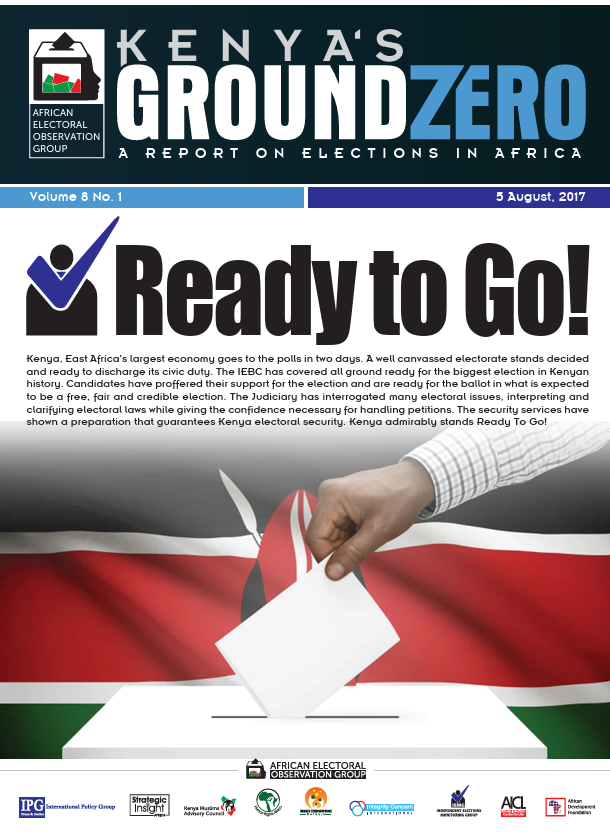
“Politicizing Security Towards Elections” is Volume 1, No. 4 of Kenya’s Ground Zero, a weekly report on Kenyan elections published by the International Policy Group (IPG), a Nairobi-based nongovernmental organization focused on peace and justice. Dated 30 January 2017, it looks at the run-up to Kenya’s 8 August 2017 general election and argues that the opposition’s recent claims about the security services are part of a strategy to discredit the electoral process. Like the report’s other material, it is openly partisan in tone and should be presented to your readers as one organization’s analysis, not neutral reporting.
The background
The report opens by describing the 2017 election as the most competitive and complex in Kenya’s history, held in a polarized environment with an electoral commission (the IEBC) short on time and credibility. It names the electoral system, including the IEBC, the Supreme Court and the security services, as the “ground zero” of the contest. This edition focuses on the security services.
The central claims
- The opposition’s allegations. On 24 January 2017, opposition leader Raila Odinga accused the National Intelligence Service (NIS) of interfering in the ongoing Mass Voter Registration (MVR) exercise. His claims included taking biometric registration kits into Uganda and Ethiopia to register foreigners, registering youths whose data came from National Youth Service exercises, and a repeat of alleged NIS involvement in the 2007 and 2013 elections. He warned the country would be sent “to the dogs” if this continued.
- The report’s reading of those claims. The author argues the allegations are alarmist and politically motivated. In its view they aim to stir tension among border communities, provoke neighbouring states, galvanize the opposition’s base, and lay the groundwork for rejecting the results if the opposition loses. It interprets the rhetoric as preparation for violence.
- The registration numbers. The report examines preliminary MVR figures, comparing each region’s share of new voters with its share of the population. It finds Central, Nairobi and the Coast ahead of their population share, while Nyanza, Western, Rift Valley and North Eastern lag behind. It argues that weak turnout in opposition strongholds explains why the opposition wants to discredit the register. It also flags an unexplained slowdown in Garissa’s figures between weeks one and two.
The responses
The report then reviews reactions to the allegations:
- Interior Cabinet Secretary Joseph Nkaissery urged the opposition to give the police a statement backing up its claims.
- President Uhuru Kenyatta dismissed the claims and urged the opposition to stop threatening violence.
- The IEBC denied that its registration kits were in the hands of outsiders.
- Jubilee politicians, including Johnstone Sakaja and Alice Ng’ang’a, accused Odinga of making excuses and inciting chaos.
The author warns that the near-identical responses from government, IEBC and Jubilee risk feeding the opposition’s narrative of a co-opted commission, and that the exchange of threats could drive polarization on both sides.
Recommendations
The report calls on the security services to guard against being drawn into electoral controversies, the opposition to respect the IEBC’s independence and let registration finish, the IEBC to consolidate and protect its systems, and Kenyans to condemn incitement to violence.
Context for readers
The report was written in January 2017, before the August election, so it reflects the debate at that moment and not later events. Its conclusions are the IPG’s own assessment, and it takes a strongly critical view of the opposition. Odinga’s allegations and the report’s interpretation of them are both contested, so you may want to add a line noting that readers should weigh them against other sources.